Mr Venables, suspected by Osborne
The Pale HorseMr Venables, the wealthy owner of Priors Court whom Zachariah Osborne suspects of following Father Gorman, occupies a carefully balanced place in the investigation: he is an established local figure with an evocative past and a plausible connection to a troubling sighting, yet his paralysis immediately complicates the accusation. His introduction gives him the standing of a cultivated country-house host; the later identification makes that respectable image part of a question about what a witness could really have seen.
Identity and Background
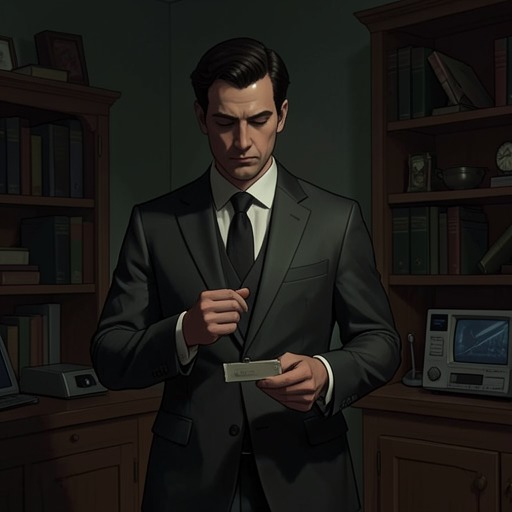
Mr Venables is about fifty and has a thin, hawk-like face, a prominent beaked nose, and an open-wing collar that lends him an old-fashioned air. The details make him recognizable without supplying evidence of wrongdoing. His public manner is hearty and hospitable: when Rhoda brings her party to lunch, he welcomes the guests and congratulates her on the success of the previous day’s event.
His circumstances are described through both former mobility and present limitation. He had polio and is semi-crippled, so he gets about in a wheelchair. Before his illness, he had been a great traveller; Rhoda presents the loss of travel as a particular sadness, not simply as a fact of his present condition. The contrast between a life associated with movement and a present life organized around a wheelchair becomes crucial when Osborne later places him in a street-side sighting.
Priors Court and Its Owner
Mr Venables bought Priors Court about three years before Rhoda’s account. The house had been an absolute ruin, falling to pieces, and its restoration had cost him a fortune. Rhoda describes it as filled with beautiful possessions and says that the sale rooms have become his principal interest. He is thus introduced not only as a man of considerable means but as someone who has redirected his former appetite for travel toward a fixed home and the acquisition of objects.
The contrast is pointed but should not be mistaken for proof of character: the account does not connect his wealth or collecting to the crimes under investigation. Instead, the restored estate makes him a prominent local presence, while his interest in sale rooms gives him an identifiable occupation after travel has become difficult. Priors Court is both his residence and the setting through which the village understands his means, taste, and changed way of life.
His View of the Pale Horse
In conversation, Mr Venables reflects on the Pale Horse as a place whose former history seems more sinister than its present use. He wishes it had remained an inn and imagines that it might once have sheltered highwaymen or concealed the disappearance of wealthy travellers. He dismisses smuggling as unlikely because the inn is too far from the sea, and finds it almost disappointing that the building has become a desirable residence for three women.
The remarks establish his interest in the atmosphere and possible history of old buildings, but they also bring him close to the story’s central imagery of disappearance and death. He treats the inn’s imagined wickedness as speculation about its past, not as a claim that its present residents are responsible for murder. The gap between this romantic, historical conjecture and the contemporary threat associated with the Pale Horse gives the conversation an uneasy resonance without turning his words into evidence against him.
The Sighting and the Suspicion
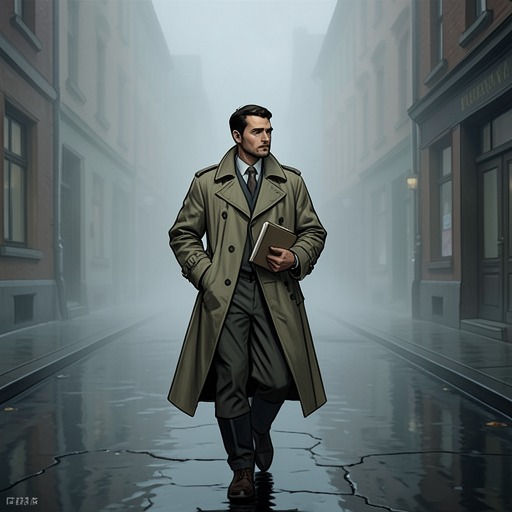
Osborne’s account supplies the most consequential fact about Mr Venables. At a village church fête, about twenty miles away, Osborne recognizes the man he says passed his shop on the night Father Gorman was killed. The recognition surprises him because the man is now propelling himself in a wheelchair. Osborne makes discreet inquiries and learns that the local resident is Mr Venables, who lives at Priors Court in Much Deeping and is said to possess considerable means. He supposes that an accident must have occurred since the earlier sighting.
This identification ties Mr Venables to the night of Father Gorman’s murder through a witness’s memory, not through a demonstrated motive or action. The report is consequential because it appears to identify the person who followed Father Gorman, but the changed circumstances also leave room for error: Osborne saw the man before learning his identity and encounters him later in a conspicuously different physical condition.
The Problem of the Wheelchair
The accusation is tested against Mr Venables’s paralysis. In the discussion of Osborne’s claim, the objection is direct: if Mr Venables has been paralyzed for years, he could not have been the man seen following Father Gorman. The possibility that the paralysis might be feigned is raised, then met with a medical counterargument: the limbs would be atrophied. The evidence therefore does not treat the wheelchair as a superficial disguise that can simply be explained away; it makes the sighting a question of physical plausibility.
That tension defines Mr Venables’s narrative role in the evidence presented here. His wealth, restored house, and interest in the Pale Horse’s supposed past make him a memorable suspect when Osborne names him. Yet the same biography that marks him as a settled, influential resident includes the disability that challenges the identification. He is significant less as a confirmed participant than as a test of how the investigation weighs coincidence, recognition, and bodily fact: a persuasive name in a witness’s account does not, by itself, settle who followed Father Gorman.